Five Types of Data Leakage
- Format leakage: Rich data compressed into flat exports (CSV, PDF, Excel)
- Context leakage: The "why" behind a decision disappears when only the "what" is transferred
- Timing leakage: By the time data arrives in the next system, it's already outdated
- Behavioural leakage: How a buyer navigated, what they hesitated on, what they removed — all gone
- Relational leakage: Connections between data points are severed during transfer
Based on projected estimates, that a European premium brand was losing 67% of wholesale interaction data between showroom and order system. After switching to FIRE, 100% was captured — contributing to CHF 12.2M in additional wholesale revenue (based on projected case study estimates) within 12 months.
Where Fashion Data Leaks — And What It Costs
Data leakage in fashion wholesale happens at every handoff point. When a showroom appointment ends and the sales rep records highlights in a personal notebook, behavioural intelligence leaks. When an order is placed by email and manually entered into the ERP, transaction context leaks. When a retailer shares sell-out data via monthly PDF reports that someone eventually enters into a spreadsheet, real-time market intelligence leaks.
Conservative estimates suggest that fashion brands lose 40–60% of potentially valuable wholesale data through process gaps, format mismatches, and system discontinuities. This isn't a technology failure — it's an architecture failure. Each system was implemented to solve a specific problem without considering how data flows between systems. The cumulative effect is an intelligence deficit that grows more costly every season as competitors with unified platforms build increasingly accurate predictive models.
The Hidden Intelligence in Wholesale Interactions
Every wholesale interaction contains far more data than the transaction it produces. A 45-minute showroom appointment generates browsing patterns (which categories attracted attention first), comparison behaviour (which alternatives were considered), price sensitivity signals (where negotiations occurred), and relationship indicators (how the conversation progressed from small talk to commitment). In a traditional workflow, 95% of this intelligence is lost.
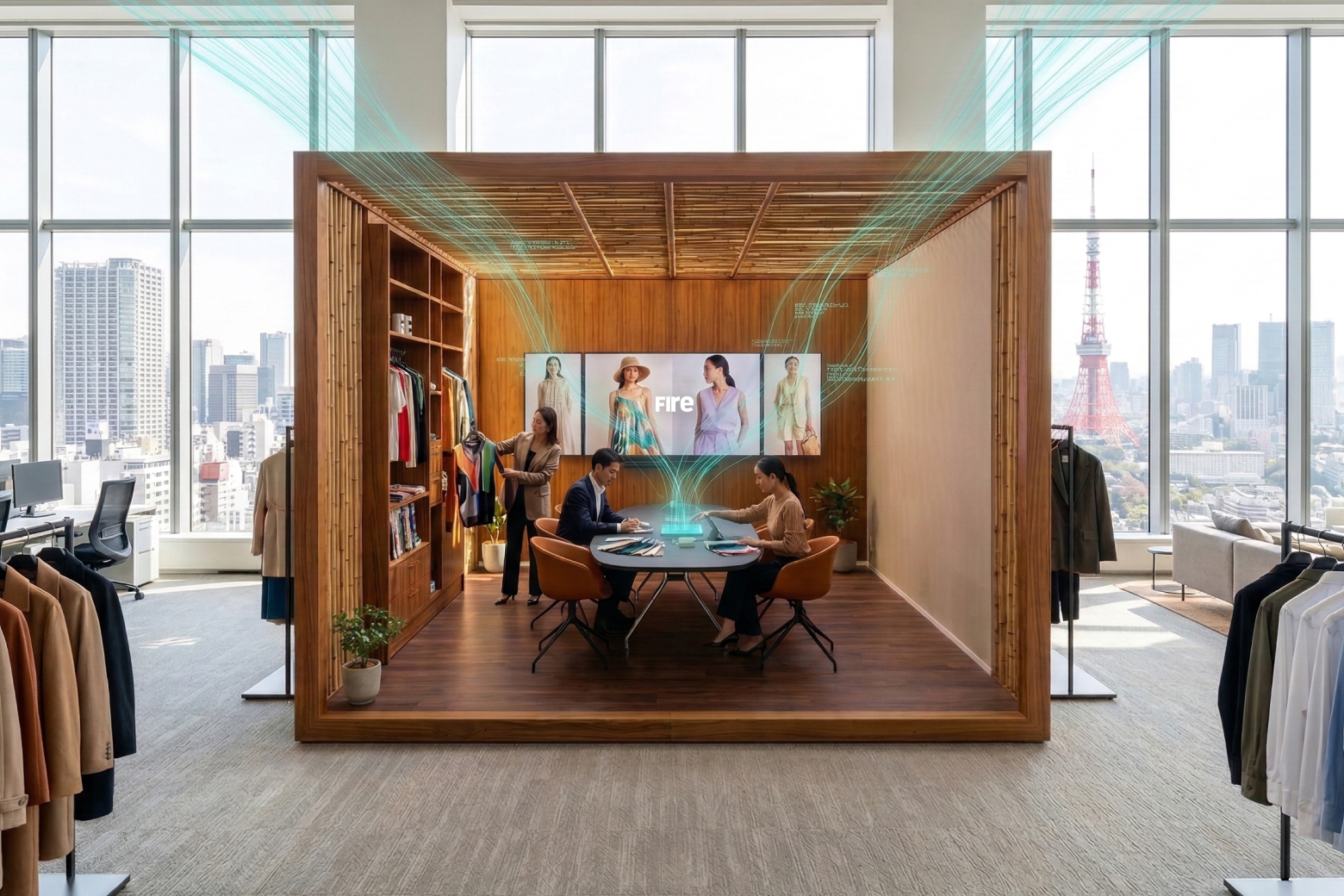
Modern wholesale platforms capture this interaction data automatically. FIRE's Digital Showroom records every product view, every collection comparison, every session duration, and every return visit. Over time, this behavioural data becomes the foundation for personalised recommendations, predictive ordering, and account-specific strategies. A brand running FIRE for three seasons has a complete behavioural profile of every buyer — their preferences, their patterns, and their potential.
This is the data that AI needs to transform wholesale from a reactive, relationship-dependent process into a proactive, intelligence-driven growth engine. Without it, even the most sophisticated algorithm is guessing. With it, every recommendation is grounded in observed behaviour across seasons.
Stopping Data Leakage: Platform vs Integration Approach
The integration approach to data leakage attempts to connect existing systems through APIs, middleware, and data warehouses. This can recover some lost data but creates its own problems: synchronisation delays, format mismatches, versioning conflicts, and ongoing maintenance costs that typically exceed the original tool investments within 18 months.
The platform approach eliminates leakage architecturally. When every wholesale interaction — from first showroom visit to final sell-out report — happens within one system, there are no handoff points where data can leak. FIRE's approach processes nearly $10 billion in annual transactions through this unified architecture. Every data point is captured at the source, in real time, with full context — because the source and the intelligence layer are the same system (projected estimate).
Quantifying Your Data Leakage
Most fashion brands have never measured their data leakage. A simple audit can reveal the scale of the problem. Count the number of system transitions in a typical order lifecycle — from first buyer contact to final delivery. Each transition represents a potential leakage point. Then estimate the information lost at each transition: showroom notes that don't enter the CRM, verbal agreements that don't match system records, feedback that stays in email threads.
Brands that conduct this audit typically discover 8–12 significant leakage points in their wholesale process, with an estimated 40–60% of behavioural and contextual data lost before it reaches any analytical system. The financial impact — measured in missed reorder opportunities, suboptimal assortments, and preventable stock-outs — typically represents 5–10% of wholesale revenue.
Taking Action: From Insight to Implementation
Understanding the challenge of data leakage is the first step. Acting on it is what separates market leaders from followers. The fashion brands that will dominate in 2028–2030 are the ones implementing unified data platforms today — building the structured intelligence foundation that makes AI-driven wholesale operations possible.
FIRE provides the fastest path from fragmented data to unified intelligence: 10 weeks from decision to go-live. Every transaction from day one captures structured, AI-ready data. Every season builds on the last. Within 2–3 seasons, the operational improvements — better forecasts, optimised assortments, reduced samples, faster reorders — generate measurable ROI while simultaneously building the data foundation for increasingly autonomous AI-driven decision-making.
Processing nearly $10 billion in annual wholesale transactions for Hugo Boss, Bugatti Shoes, Drykorn, LVMH and 100+ leading fashion and lifestyle brands worldwide, FIRE demonstrates that the path from data challenges to data-driven competitive advantage is proven, repeatable, and available today. The only variable is when you start — and every season of delay is a season of intelligence permanently lost (projected estimate).