Beyond ERP. Beyond CRM. Beyond BI.
A fashion data platform is not an ERP, a CRM, or a BI tool. It's the intelligence layer that sits above and connects all of these — capturing what falls between the cracks of disconnected systems.
ERPs manage master data and transactions. CRMs manage relationships. BI tools visualise historical data. None of them capture the complete picture of what happens when a buyer interacts with a collection, places a preorder, reorders based on sell-out, and builds a long-term purchasing pattern.
A fashion data platform captures all of this — and structures it for AI. That's the difference between having data and having intelligence.
Why Fashion Is Different
- Seasonality: Fashion operates in compressed cycles where data from one season must inform the next — but most systems don't connect them
- Size matrices: A single style can have 50+ SKU variants across sizes and colours — creating exponentially more data points than other industries
- Multi-market complexity: Different currencies, pricing, regulations, and buyer behaviours across regions
- Sell-in/sell-out disconnect: What brands ship (sell-in) and what retailers sell (sell-out) are rarely connected
- Preorder/reorder cycle: The feedback loop between initial orders and replenishment is the most valuable data connection in wholesale — and the most commonly broken
FIRE as a Fashion Data Platform
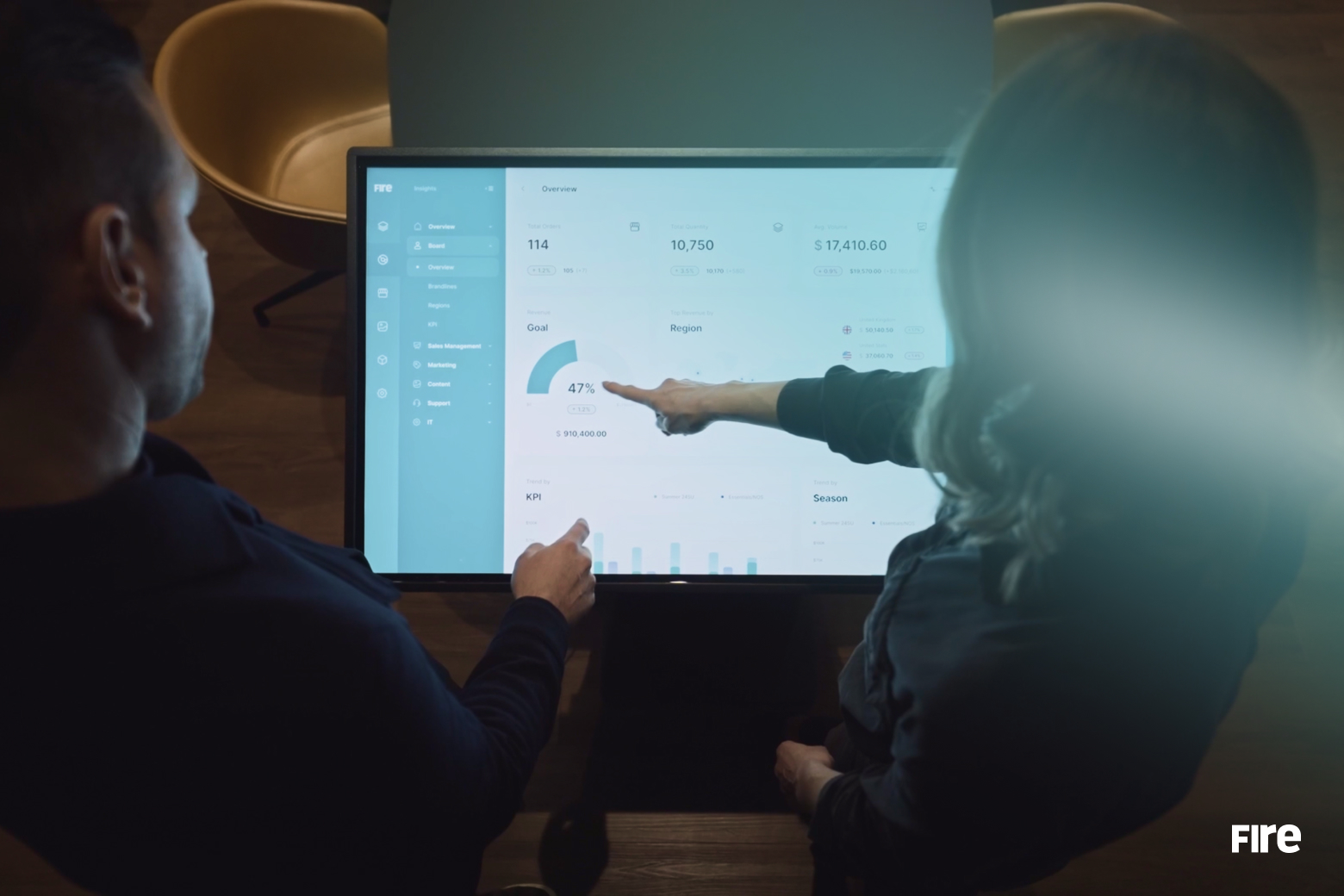
FIRE is the world's most powerful example of a fashion data platform in action. Processing over nearly $10 billion in annual transactions for 100+ leading brands, FIRE captures every wholesale interaction — showroom presentations, order placement, pricing negotiations, reorder triggers, sell-out performance — in one unified system.
The result: structured intelligence that compounds with every season, powering AI-driven decisions that get smarter over time.
What Makes a Platform Different from a Collection of Tools
A fashion data platform is fundamentally different from a suite of integrated tools. Tools are designed to solve individual problems: a showroom tool for product presentation, an order management tool for transaction processing, an analytics tool for reporting. A platform is designed to solve the data problem: capturing, structuring, connecting, and activating data across all wholesale functions in a single architectural layer.
The practical difference is profound. In a tool-based architecture, data is created in one system, copied to another, transformed in a third, and analysed in a fourth. Each step introduces delays, quality degradation, and context loss. In a platform architecture, data is created, structured, connected, and available for analysis simultaneously — because all functions operate on the same data layer.
Evaluating Fashion Data Platforms
When evaluating data platforms for fashion, five criteria matter most. First, fashion specificity: does the platform natively handle size-colour matrices, seasonal lifecycles, and multi-market complexity? Second, data capture breadth: does it capture behavioural data (showroom interactions) as well as transactional data (orders)? Third, ERP connectivity: can it synchronise bidirectionally with your enterprise systems? Fourth, scalability: can it grow from 5 markets to 50 without architectural redesign? Fifth, data sovereignty: do you own 100% of the data captured through the platform?
FIRE meets all five criteria by design. Purpose-built for fashion from day one, it captures the complete wholesale lifecycle from showroom to sell-out, connects to major ERPs through proprietary middleware, scales globally with multi-brand and multi-currency support, and guarantees complete data sovereignty. Processing nearly $10 billion in annual transactions across 100+ brands demonstrates both the architecture's robustness and its fashion-specific design (projected estimate).
Strategic Implications for Fashion Brands
The implications of what is fashion data platform extend beyond operational efficiency to strategic competitive advantage. Brands that address this challenge through unified platform architecture create structural advantages that compound over time. Every season of structured data capture builds intelligence that informs better decisions, which generate better data, which enables even better decisions.
FIRE's approach to what is fashion data platform is architectural rather than incremental. Rather than adding another tool to an already fragmented stack, the platform replaces disconnected systems with a unified data layer where every wholesale interaction — from showroom appointment to sell-out reporting — generates structured, AI-ready intelligence automatically.
The FIRE Advantage in What Is Fashion Data Platform
Processing nearly $10 billion in annual wholesale transactions for Hugo Boss, Bugatti Shoes, Drykorn, LVMH and 100+ leading fashion and lifestyle brands worldwide, FIRE demonstrates that what is fashion data platform is not a theoretical challenge but a solved problem. The platform's 10-week implementation timeline means brands can begin capturing structured data within a single quarter (projected estimate).
The return on investment manifests within 2–3 seasons: improved forecast accuracy, optimised assortments, reduced sample costs, faster reorder cycles, and deeper retailer relationships. These operational improvements generate 15–25% wholesale efficiency gains while simultaneously building the data foundation required for advanced AI capabilities in subsequent seasons.
Taking Action: From Insight to Implementation
Understanding the challenge of what is data platform is the first step. Acting on it is what separates market leaders from followers. The fashion brands that will dominate in 2028–2030 are the ones implementing unified data platforms today — building the structured intelligence foundation that makes AI-driven wholesale operations possible.
FIRE provides the fastest path from fragmented data to unified intelligence: 10 weeks from decision to go-live. Every transaction from day one captures structured, AI-ready data. Every season builds on the last. Within 2–3 seasons, the operational improvements — better forecasts, optimised assortments, reduced samples, faster reorders — generate measurable ROI while simultaneously building the data foundation for increasingly autonomous AI-driven decision-making.
Processing nearly $10 billion in annual wholesale transactions for Hugo Boss, Bugatti Shoes, Drykorn, LVMH and 100+ leading fashion and lifestyle brands worldwide, FIRE demonstrates that the path from data challenges to data-driven competitive advantage is proven, repeatable, and available today. The only variable is when you start — and every season of delay is a season of intelligence permanently lost (projected estimate).